KAPISTREE
Queen of Ithaca
Queen of Ithaca
Couldn't load pickup availability
Three exceptional Greek and Etruscan gold artefacts from the 7th century BC, set with 30 carats of moonstone in a handmade gold necklace and earrings.
'Queen of Ithaca' brings together two ancient Greek gold beads and an Etruscan gold pendant, all created during one of the most fascinating moments of change in the ancient Mediterranean.
The 7th century BC stood at the threshold between the ordered world of the Greek Geometric period and the increasingly outward-looking Orientalising age. Trade and travel were bringing Greece into deeper contact with cultures to the east, introducing new techniques, imagery and ways of telling stories. It was around this same threshold that Homer's Odyssey took form: a work built upon strict poetic structures, yet filled with journeys beyond the known world, strange lands, encounters and transformation.
This ancient gold captures that transition in miniature. The two Greek beads set in the earrings are each barely 10mm long, yet represent an extraordinary investment of craft. One, of 18.4 carat gold, is meticulously assembled from 180 individual components. The other, of 20.2 carat gold, is made from 36 parts, using fine wirework and granulation. Their underlying construction remains geometric while the surfaces reveal a more intricate and organic style. Granulation itself was a technique being revitalised in the Greek world through renewed contact with the sophisticated goldsmithing traditions of the eastern Mediterranean.
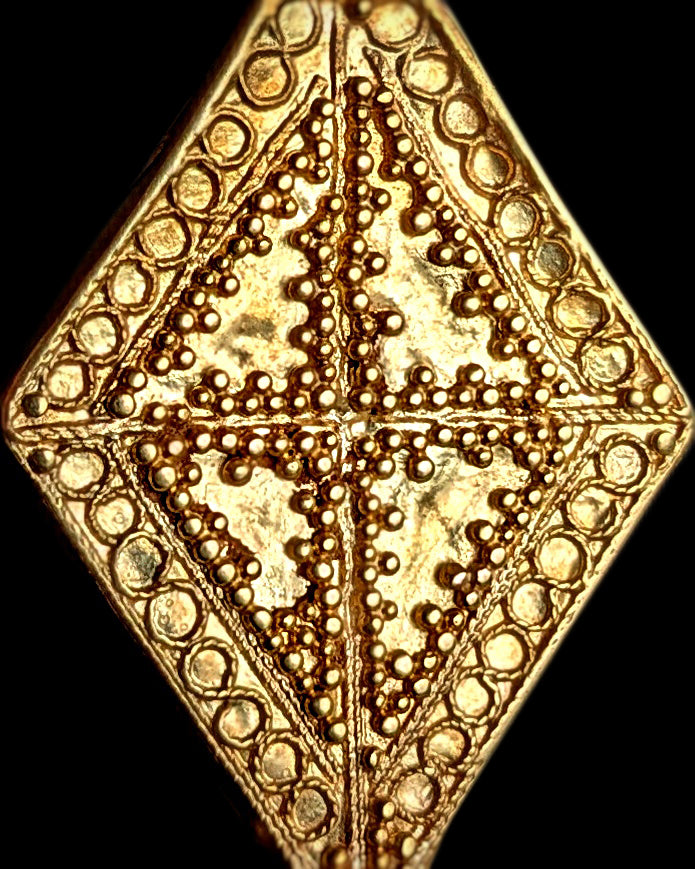
Suspended at the centre of the necklace is a hollow Etruscan gold pendant, also dating to the 7th century BC. Its diamond-shaped form is divided into four disciplined geometric quarters, worked on both sides with exceptionally fine twisted wire and granulation. Some of the ropework measures only 0.2mm across, the finest known from Etruscan workshops. Granules grow outwards from the centre like seeds, collecting along the boundaries of each quadrant. A handful escape, crossing the carefully defined border and appear on the outer frame of the pendant itself. Within an object only a few centimetres across, the ancient goldsmith establishes an order and then allows individual elements to break free from it.
It is an almost perfect visual expression of an age in transition. Named for Penelope, Queen of Ithaca, the set reflects the world in which her story emerged: constraint and structure versus exploration and freedom, an old order giving way to something new. Jewellery often preserves these cultural shifts more intimately than monumental art because it was an intuitive expression. Its materials, techniques and aesthetic decisions record the spirit of their moment.
Set with 26 carats of finest blue moonstones, the necklace also holds a central 4-carat Madagascar rainbow moonstone that flashes sunset red, a light between two ages. Queen of Ithaca is jewellery about that moment of becoming - the rise and fall of eras, 2,700 years ago and ever present.
Share