KAPISTREE
Alektor
Alektor
Couldn't load pickup availability
Pre-order
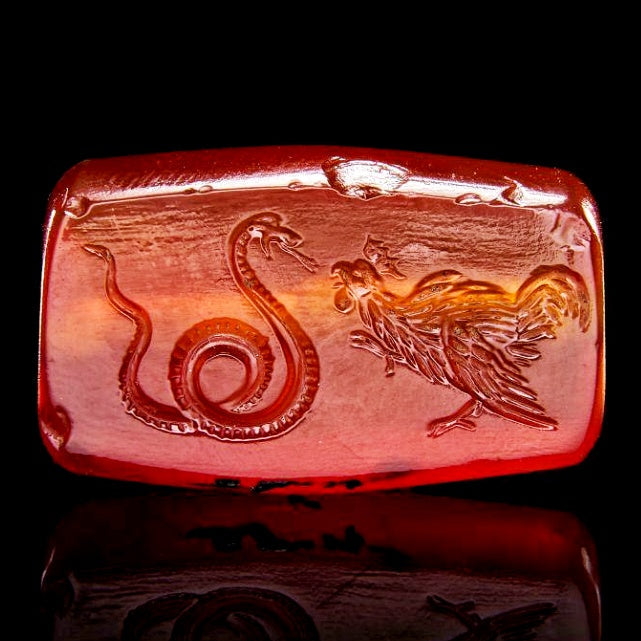
An extremely fine quality carnelian stone with an equally refined Classical Greek intaglio, depicting the moment before combat between a coiled serpent or drakōn and a rooster - 5th century BC.
In ancient Greece, the rooster was a symbol of agôn or competitive struggle. The Metropolitan Museum has an Attic amphora from 570–560 BC on which two warriors fight on one side and two roosters confront one another on the other, noting that the two subjects can be regarded as complementary.
The 2nd century Greek author Aelian tells the story that, before battle, Themistocles pointed out fighting cocks to his soldiers, observing that the birds fought simply because neither would submit to the other. The episode was supposedly commemorated in annual Athenian cockfights. This shows us how Greeks understood the image of a rooster: unyielding courage and refusal to be defeated.
Aelian also said that "the deadly basilisk fears the cock: it trembles at the sight of one and dies when it hears the cock crow". The basilisk was a type of drakōn or mythical serpent. Travellers in Libya therefore took a cock with them as protection against the creature.
The Walters Art Museum has a Greek ivory disc seal, probably 7th century BC, on which a rooster is striding with open beak and raised wing, with snakes above and below it. Such seals were found in sanctuaries including Artemis Orthia at Sparta, Hera Limenia at Perachora and the Argive Heraion. However this remarkable carnelian intaglio is possibly unique in showing a drakōn serpent specifically, the dramatic scene poised at the moment just before combat - a composition beloved in late Archaic and early Classical art for its contained tension.
The gem is soon to be reborn in a remarkable one-of-a-kind ring. Contact to enquire.
Share